
Technical Architecture Analysis and Expansion Strategy for MANFRED.io Construction Materials Procurement Platform
Based on my analysis of the MANFRED.io presentation, I have developed a comprehensive technical architecture that addresses both the current electrical distribution challenges and the broader construction materials procurement expansion opportunity across South America[^1]. The proposed solution leverages cutting-edge AI technologies, serverless architecture, and graph databases to create a scalable, cost-effective platform capable of handling complex procurement workflows[^2][^3].
MANFRED.io has demonstrated significant potential in the electrical distribution market, achieving a 384x efficiency improvement in RFQ processing and reducing response times from 32 hours to just 5 minutes[^1]. The platform's success with 95% AI accuracy and zero hallucinations on electrical specifications provides a strong foundation for expansion into the broader construction materials market[^1]. The current solution addresses critical pain points including 35% unanswered RFQs, 18% error rates, and $6.8M annual losses per distributor due to inefficiencies[^1].
The expansion strategy targets the $11.3B construction materials market across key South American countries, with particular focus on Peru, Brazil, Argentina, and Chile[^1][^4]. This represents a significant opportunity to scale beyond electrical components into concrete products, steel materials, lumber, plumbing supplies, and specialized construction systems[^4].
The proposed architecture consists of six distinct layers designed for maximum scalability and efficiency[^5][^6]. The system employs a serverless-first approach that automatically scales based on demand while maintaining cost-effectiveness through pay-per-use pricing models[^7][^8].
graph TD
    User_Chat_Or_Phone --> API_Gateway
    API_Gateway --> AI_Agent_Layer
    AI_Agent_Layer --> Data_Ingestion_Processing
    Data_Ingestion_Processing --> OCR_Scraping_API
    OCR_Scraping_API --> Structured_Data_Layer
    Structured_Data_Layer --> Neo4j_GraphDB
    Structured_Data_Layer --> Relational_DB
    AI_Agent_Layer --> Recommendation_Engine
    Recommendation_Engine --> Neo4j_GraphDB
    AI_Agent_Layer --> Inventory_Order_Management
    Inventory_Order_Management --> Relational_DB
    Inventory_Order_Management --> Supplier_Systems_API
    Inventory_Order_Management --> Shipping_Booking_Systems
    Neo4j_GraphDB --> Product_Relationship_Graph
    Relational_DB --> Product_Catalog_Stock_Pricing
    AI_Agent_Layer --> Audit_Metrics_Tracking
    Audit_Metrics_Tracking --> Relational_DB
    Audit_Metrics_Tracking --> Neo4j_GraphDB
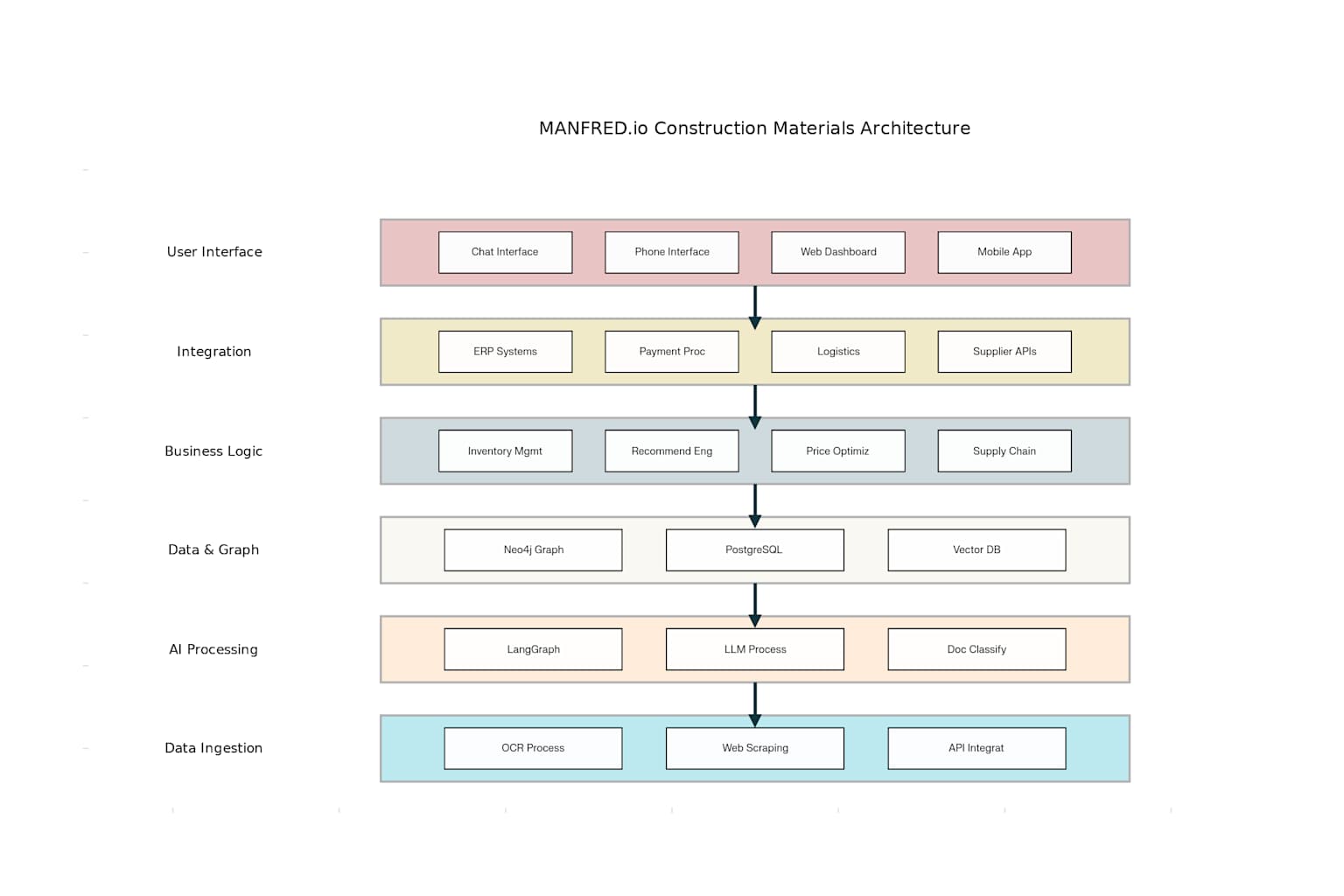
High-Level Architecture for MANFRED.io Construction Materials Procurement Platform
The architecture incorporates advanced AI processing capabilities through LangGraph multi-agent systems, enabling sophisticated workflow orchestration and intelligent decision-making[^9][^10]. Each layer serves a specific purpose: data ingestion handles diverse input sources, AI processing normalizes and classifies information, the data layer manages both structured and graph relationships, business logic coordinates procurement workflows, user interfaces provide multiple interaction channels, and integration layers connect with external systems[^2][^5].
The technical implementation leverages AWS serverless services to create a robust, scalable platform capable of handling high-throughput data processing and real-time user interactions[^7][^11]. The architecture employs Lambda functions for compute tasks, Step Functions for workflow orchestration, and various managed services for data storage and processing[^12][^13].
graph TD
    User_Chat_Voice_Web --> API_Gateway
    API_Gateway --> Lambda_Orchestration
    Lambda_Orchestration --> Textract_OCR
    Lambda_Orchestration --> Web_Scraper_Lambda
    Lambda_Orchestration --> Supplier_API_Connector
    Textract_OCR --> Data_Normalization_Lambda
    Web_Scraper_Lambda --> Data_Normalization_Lambda
    Supplier_API_Connector --> Data_Normalization_Lambda
    Data_Normalization_Lambda --> S3_Storage
    Data_Normalization_Lambda --> Bedrock_LLM
    Bedrock_LLM --> Structured_Output_Lambda
    Structured_Output_Lambda --> Neo4j_AuraDB
    Structured_Output_Lambda --> RDS_PostgreSQL
    Lambda_Orchestration --> Recommendation_Lambda
    Recommendation_Lambda --> Neo4j_AuraDB
    Recommendation_Lambda --> RDS_PostgreSQL
    Lambda_Orchestration --> Amazon_Connect
    Lambda_Orchestration --> CloudWatch_XRay
    Lambda_Orchestration --> Cognito_Auth
    Lambda_Orchestration --> CloudFront_CDN
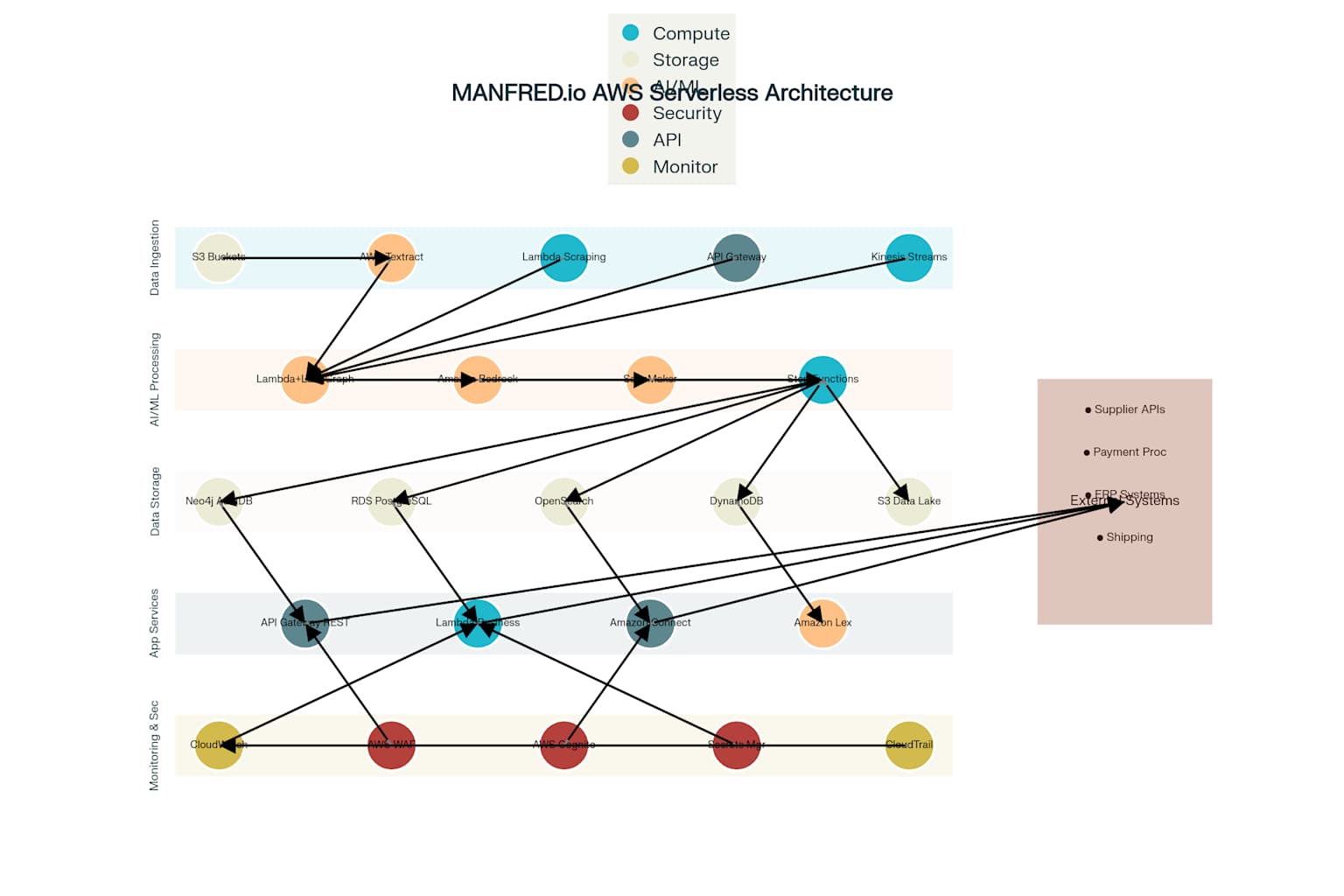
Detailed AWS Serverless Architecture for MANFRED.io Platform
Key components include AWS Textract for OCR processing of PDF catalogs and Excel sheets, Amazon Bedrock for LLM capabilities, and Neo4j AuraDB for graph database functionality[^14][^8]. The system utilizes API Gateway for RESTful services, Amazon Connect for phone interface integration, and CloudFront for global content delivery[^7][^15]. Security measures include AWS WAF, Cognito for authentication, and comprehensive monitoring through CloudWatch and X-Ray[^15].
The data processing pipeline handles multiple input sources including PDF catalogs, Excel sheets, supplier websites, ERP systems, and real-time API feeds[^14][^16]. The system employs a combination of OCR processing, web scraping, and API integration to normalize diverse data formats into structured information suitable for graph database population[^16][^17].
flowchart LR
    Unstructured_Data --> OCR_Scraping
    OCR_Scraping --> AI_LLM_Parsing
    AI_LLM_Parsing --> Data_Validation_Normalization
    Data_Validation_Normalization --> Structured_Data
    Structured_Data --> Product_Catalog_Inventory_Suppliers
    Product_Catalog_Inventory_Suppliers --> User_Query
    User_Query --> AI_Agent_System
    AI_Agent_System --> Query_DB_Graph
    Query_DB_Graph --> Return_Results
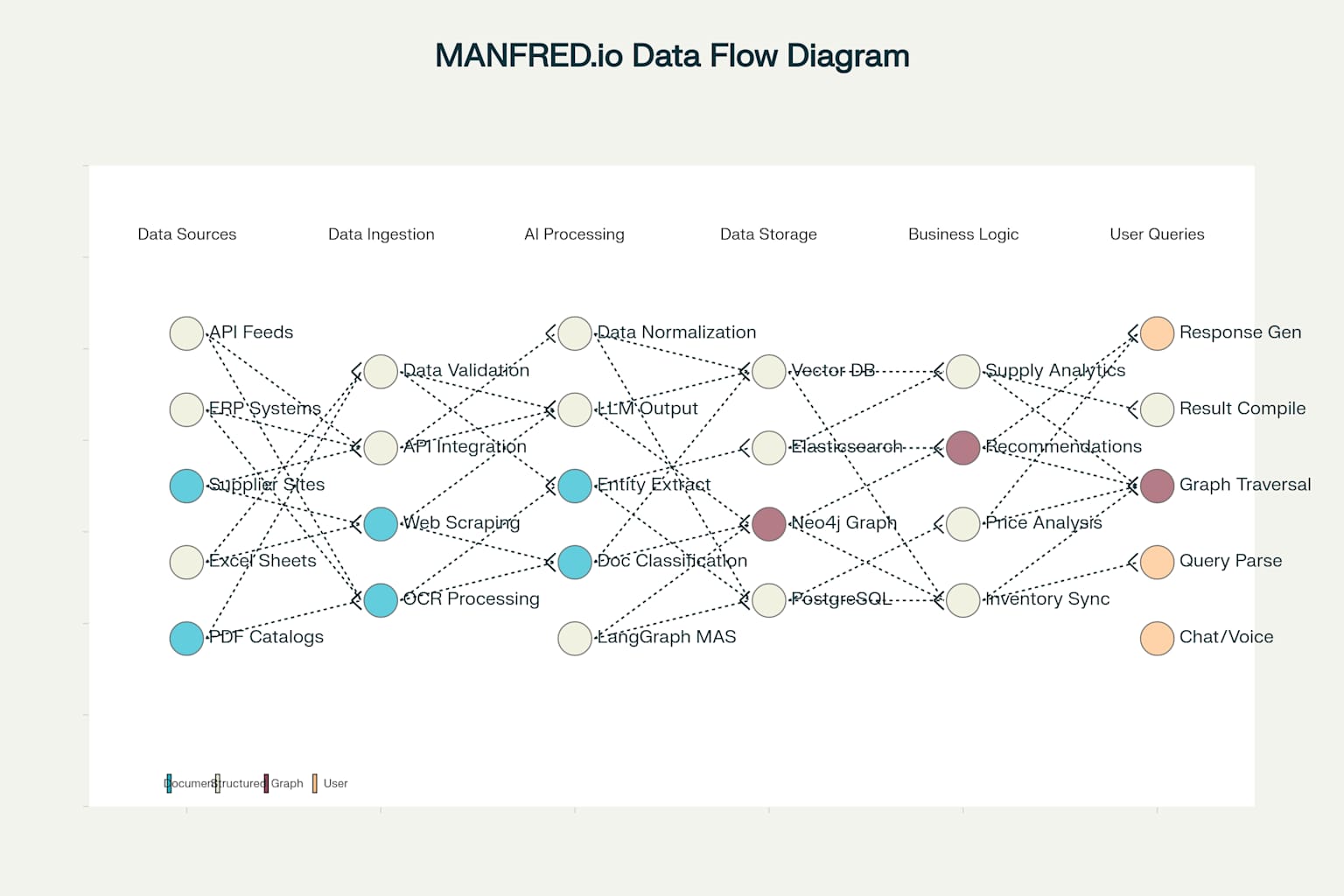
Data Flow Diagram for MANFRED.io Construction Materials Procurement Platform
The processing flow begins with document ingestion, proceeds through AI-powered classification and extraction, and culminates in real-time inventory synchronization and recommendation generation[^16]. The pipeline maintains data quality through validation checks and employs vector embeddings for semantic search capabilities[^17]. Processing times are optimized for sub-second response times on user queries while maintaining high accuracy in data extraction and classification[^17].
The system supports multiple interaction channels including chat interfaces, voice calls, and web dashboards, all integrated through a unified query processing architecture[^18][^19]. Natural language processing capabilities enable users to make complex inventory inquiries using conversational language[^20][^3].
classDiagram
    class UserInterface {
        +Chat
        +Phone
        +WebDashboard
    }
    class APIService {
        +REST_API
        +WebSocket
    }
    class AIAgentSystem {
        +LangGraph_Agents
        +LLM_Parsing
        +Recommendation_Engine
    }
    class DataIngestion {
        +OCR
        +Web_Scraping
        +Supplier_API
    }
    class DataStorage {
        +Neo4j_GraphDB
        +PostgreSQL
        +S3_Storage
    }
    class SupplierIntegration {
        +Inventory_Sync_API
        +Order_Submission
    }
    class AuditMetrics {
        +Order_Tracking
        +Quality_Metrics
    }

    UserInterface --> APIService
    APIService --> AIAgentSystem
    AIAgentSystem --> DataIngestion
    DataIngestion --> DataStorage
    AIAgentSystem --> DataStorage
    AIAgentSystem --> SupplierIntegration
    SupplierIntegration --> DataStorage
    AIAgentSystem --> AuditMetrics
    AuditMetrics --> DataStorage
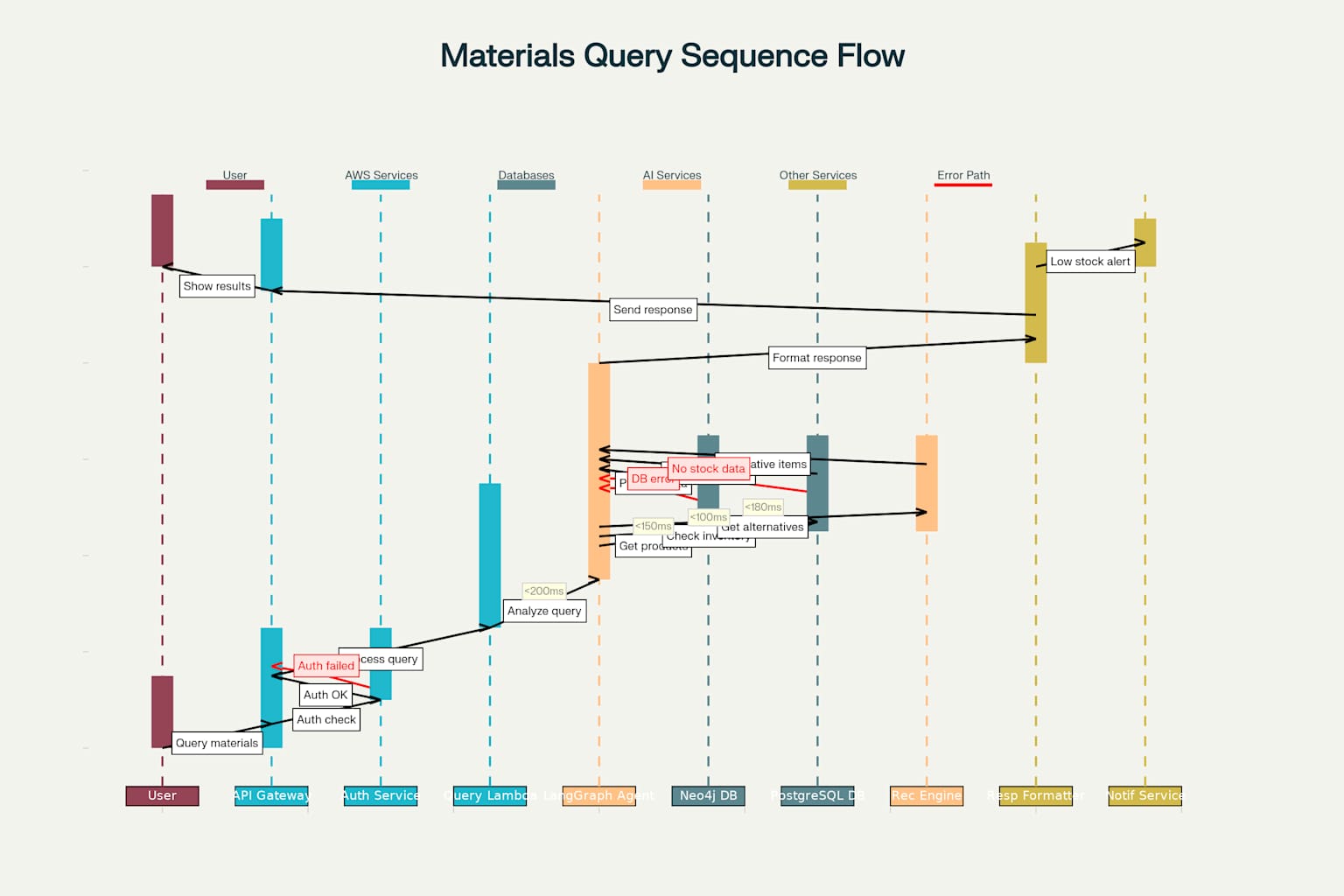
UML Sequence Diagram - User Query Processing in MANFRED.io Platform
The query processing sequence involves authentication through AWS Cognito, natural language parsing via LangGraph agents, parallel database queries across Neo4j and PostgreSQL systems, and intelligent response formatting with pricing and availability information[^9][^18]. The system maintains sub-500ms response times for simple queries while supporting complex multi-parameter searches across product relationships[^17].
The core innovation lies in the three-dimensional graph structure that models complex product relationships, supplier networks, and compatibility matrices[^21][^22]. The graph database enables sophisticated recommendation algorithms that can identify complementary products, alternative substitutes, and supply chain dependencies[^22].
graph TD
    Pipe -->|Requires| PipeHolder
    PipeHolder -->|Requires| Nail
    Pipe -->|Substitutes| PVC_Pipe
    Pipe -->|CompatibleWith| Joint
    Joint -->|CompatibleWith| PipeHolder
    Pipe -->|SuppliedBy| SupplierA
    PipeHolder -->|SuppliedBy| SupplierB
    Nail -->|SuppliedBy| SupplierC

Neo4j 3D Graph Database Architecture for Construction Materials Recommendations
The graph structure employs multiple node types including products, categories, suppliers, projects, and specifications, connected through relationship types such as REQUIRES, COMPATIBLE_WITH, SUBSTITUTES, and SUPPLIES[^21]. The recommendation engine utilizes graph traversal algorithms to identify products that complement user selections, similar to the pipe-to-pipe-holders-to-nails example mentioned in the requirements[^22]. This approach enables cross-selling opportunities and increases average order values while ensuring compatibility between selected materials[^22].
The deployment architecture emphasizes cost-effectiveness through serverless patterns, automatic scaling, and geographic distribution across South American regions[^6][^23]. The system employs event-driven architecture to minimize idle resource consumption while maintaining responsive performance during peak usage periods[^6][^7].
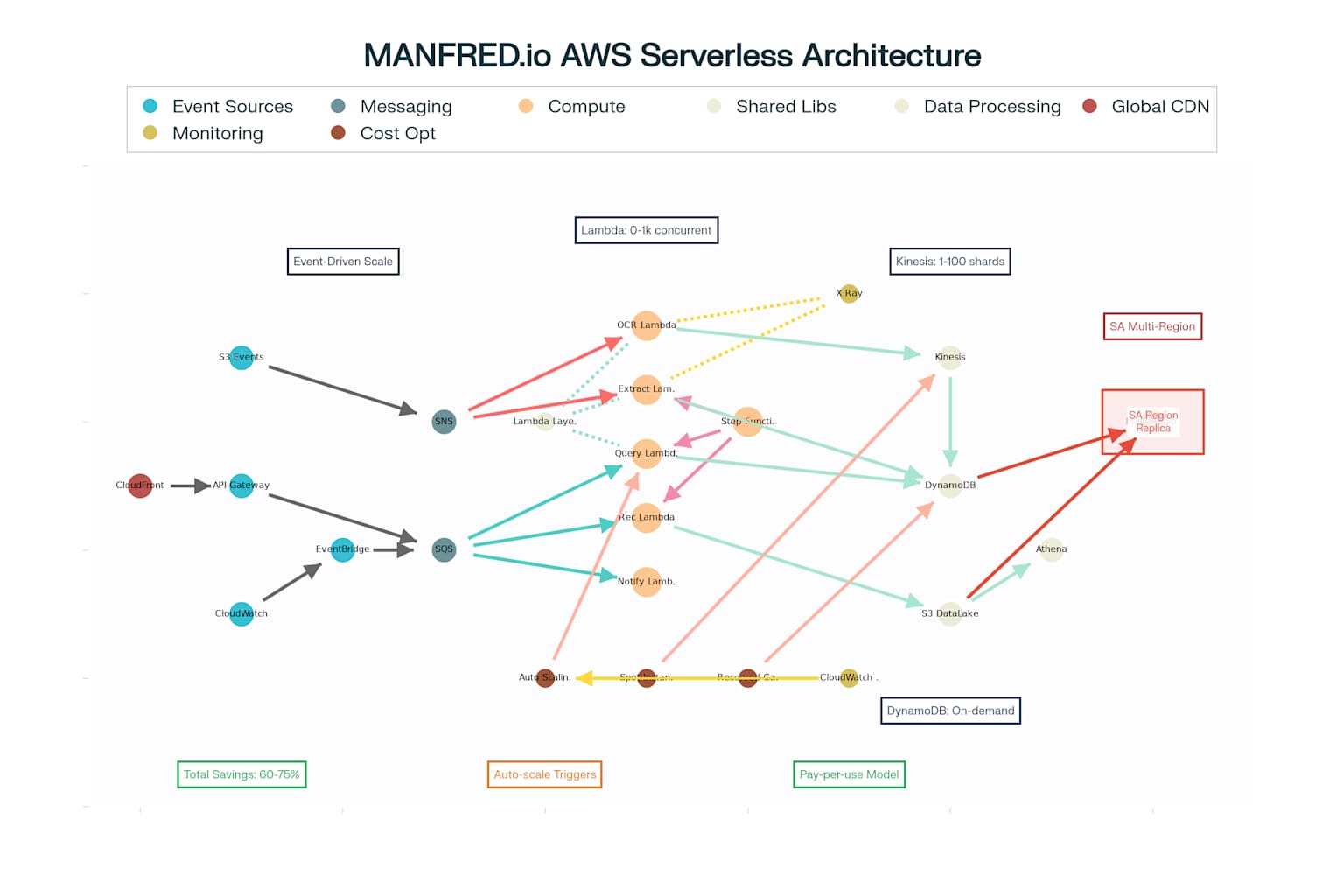
AWS Serverless Deployment Architecture with Cost-Effective Scaling for MANFRED.io
Cost optimization strategies include auto-scaling Lambda functions, reserved capacity for predictable workloads, intelligent S3 storage tiering, and regional deployment to reduce latency[^7][^11]. The architecture supports multi-region deployment with CloudFront edge locations for optimal user experience across South America[^7]. Monitoring and observability features provide comprehensive insights into system performance and cost allocation[^8][^15].
The expansion strategy targets specific material categories in phases, beginning with core construction materials and progressively adding specialized components[^1][^4]. Phase 1 focuses on concrete products, steel materials, lumber, and basic hardware[^1]. Phase 2 introduces plumbing materials, electrical components, insulation, and roofing materials[^1]. Phase 3 encompasses HVAC systems, fire safety equipment, smart building technologies, and sustainable materials[^1].
Market-specific features include multi-language support for Spanish and Portuguese, local currency handling, regional supplier network integration, and compliance with South American building codes and standards[^4][^24]. The platform addresses the unique challenges of the Latin American construction market, which is valued at $464.50 billion in 2024 and projected to reach $514.29 billion by 2030[^4].
flowchart LR
    Phase1_Core_Materials --> Concrete
    Phase1_Core_Materials --> Steel
    Phase1_Core_Materials --> Lumber
    Phase1_Core_Materials --> Bricks
    Phase2_Specialized_Materials --> Plumbing
    Phase2_Specialized_Materials --> Electrical
    Phase2_Specialized_Materials --> Insulation
    Phase2_Specialized_Materials --> Roofing
    Phase3_Advanced_Systems --> HVAC
    Phase3_Advanced_Systems --> Fire_Safety
    Phase3_Advanced_Systems --> Smart_Tech
    Phase3_Advanced_Systems --> Sustainable
The LangGraph multi-agent system orchestrates complex workflows through specialized agents including supervisor, data extraction, classification, query processing, recommendation, inventory, and pricing agents[^9][^10]. Each agent operates independently while coordinating through the supervisor agent to handle complex procurement scenarios[^25][^18].
The Model Context Protocol (MCP) servers provide seamless integration with ERP systems, supplier APIs, and inventory management platforms[^23]. LLM structured outputs ensure consistent data formatting and enable sophisticated natural language understanding for user queries[^20][^3]. The system maintains high accuracy through validation checks and human-in-the-loop processes for edge cases[^3].
The implementation follows a four-phase approach spanning 12 months, beginning with foundation infrastructure and progressively adding advanced features[^1]. Phase 1 establishes core serverless infrastructure and basic agent implementation[^1]. Phase 2 enhances recommendation engines and real-time synchronization[^1]. Phase 3 expands material categories and regional coverage[^1]. Phase 4 optimizes AI models and enterprise integration capabilities[^1].
Resource requirements include senior full-stack engineers, AI/ML specialists, DevOps engineers, and UI/UX designers[^1]. Monthly AWS infrastructure costs are estimated between $6,500-16,500, scaling with usage patterns and data processing requirements[^1]. The investment aligns with the demonstrated ROI potential from the electrical distribution pilot, which showed 6x customer ROI through time savings[^1].
The architecture supports horizontal scaling through Lambda function auto-scaling, multi-region deployment, and database read replicas[^6][^7]. Performance targets include sub-500ms query response times, 99.9% system availability, and support for 10,000+ concurrent users[^17]. The system processes over 1 million products per hour during peak ingestion periods while maintaining data quality and accuracy[^17].
Vertical scaling options include Lambda memory optimization, database instance sizing, and Elasticsearch cluster scaling based on search performance requirements[^11][^17]. The serverless approach ensures cost-effective scaling during variable demand periods while maintaining consistent performance standards[^7][^8].
Comprehensive security measures include AWS WAF for application protection, Cognito for authentication, Secrets Manager for credential storage, and CloudTrail for audit logging[^15]. The platform addresses data privacy requirements including GDPR compliance for European suppliers and LGPD compliance for the Brazilian market[^1].
Monitoring capabilities encompass CloudWatch metrics, X-Ray distributed tracing, custom business dashboards, and automated alerting for system anomalies[^15]. Key performance indicators track system response times, user engagement, data processing accuracy, cost per transaction, and supplier integration success rates[^1].
This comprehensive technical architecture positions MANFRED.io to capture significant market share in the South American construction materials procurement sector while maintaining the operational efficiency and accuracy demonstrated in electrical distribution[^1][^4]. The combination of serverless infrastructure, AI-powered processing, and graph database technology creates a powerful platform capable of handling complex procurement workflows at scale[^2][^21][^7].
The solution addresses critical market needs including inventory visibility, supplier coordination, and intelligent recommendations while providing substantial cost savings and efficiency improvements for construction companies across the region[^26][^4]. The modular architecture enables rapid expansion into new material categories and geographic markets while maintaining consistent performance and user experience standards[^1][^6].