
Lately I've been thinking about the crosses that people bear, how they got there and this lil' ol' thing called "toxic* giving".
- *after a few test-drives, I officially endorse the usage of the word "toxic" in its social connotation. It's not a reflection of the coddled over-sensitive snowflake culture that wouldn't have won the war. It is an acknowledgement that we can be shitty to each other in a variety of subtle ways and that these can have just as meaningful impacts as even physical stresses.
To start, it'll be helpful to align on some basics of give-and-take to see the possibilities of over-giving or under-taking.
DISCLAIMER: I hope this doesn't come across as "mansplaining", but rather a helpful bridge between our two understandings and the coloring-in of a mental picture that I hope we both can see. Too often we talk at cross purposes because we don't take the time to establish the simplest parts of an idea. If we can't align on the small stuff, how can we do so on the big stuff? So! Instead of being patronized by anything that seems self-evident, I hope you're at most at a level of "yeah yeah get on with it".
Life, in all its sepia-filtered mystique, is all about give-and-take. It's so instinctive that I'd argue it's embedded into every single interaction that we take part in, even supposedly cold calculated ones, like business.
Communities and relationships fall into natural cadences of give-and-take, sometimes guided by explicit rules, but almost always powered by unspoken understandings. People probably have some natural predisposition to giving and taking, then experience the usual tempering during their upbringing and formative years, finally conforming in various ways to their environment and means*.
- *is this not just a very generic and uninsightful description that could be applied to literally anything?! It's fiiiine, I guess.
In any-given situation we work towards some semblence of a "healthy balance" with giving and taking. We're trying to avoid a state where it feels as if we're under-giving or over-taking. Most of the time, there's a lot of room to work with, lots of slack being cut all-around and it just works, though some situations are more sensitive than others*.
- *see: "Wedding Gifts: A Tale of People Creating Problems For Themselves to Solve"
So! We're walking around with these internal trackers, however consciously, and have some idea of the balance between giving and taking. If imbalances happen, they'll most likely be fleeting or get smoothed over pretty quickly. Even if there are occasional tensions, most get corrected with a small reciprocation* or even just a little venting to a sympathetic ear.
- * "Omg no! You blazed me on, like, 1000 spliffs last month, I got this!"
NOTE: in this social arithmetic, it's not really an "absolute cost" that we're keeping track of. It's some weird, highly-personal thing that's different for everyone. I think the term "friend cost" describes this nicely, which evokes all sorts of vague things like appreciation, respect, engagement and effort.
With this basic tally in mind, I'm particualrly interested in when the balance is thoroughly disrupted and cannot be corrected instinctively. All things being equal, we love givers and despise takers. It's easy to think of examples where someone is giving too little or taking too much, which are the most common sources of imbalance.
What about giving too much or taking too little? While the threshold for these things might be quite high or the factors that make them unsustainable are particularly subtle, I think they can happen. I think we're generally ill-equipped when they do.
If you give a lot then you're likely adding value to the lives of the people around you. The giving could be anything, tangible or not: money, time, expertise, a shoulder to cry on, a friendly ear that listens, or advice.
The act in-and-of-itself is almost always hugely positive and our sensitivities match this. We like people who give and instinctively celebrate them or respond in kind. Giving has a tendency to elevate any situation by creating a synergistic feedback loop which seems like a pretty good default state to fall into! Thus,
give more, give often!
There are a couple hangups with giving, though. It takes a lot to get to a point where you hear responses like, "ugh I can't believe they brought a bottle of wine again" or "wow who're they trying to impress, cleaning up all the time?", but it does happen. There are subtle social sensitivies you might infringe on and so over-giving is possible. Here's a few examples:
- you offend someone's pride by "going too far", which might imply or expose their lack of something (e.g. you clean someone's floors when you go over to their house)
- you always give and make it difficult to reciprocate, which creates an imbalance (e.g. always paying for dinner and making it difficult to oppose)
- returning a favor 10x (e.g. a diamond necklace for a car ride)
These examples bring up some common factors that affect our tallying: pride, sense of independence, desire not to be indebted. There are many more.
If you don't take a lot, it's generally a good thing. People probably notice this and think you're considerate, respectful or independent. If people give a lot and take a little then everyone collectively will have more to spare. This also seems like a pretty good default state!
I don't think they're as obvious as over-giving scenarios, but under-taking is possible too! To me, this boils down to a few instincts:
- you can seem stubborn or prideful if you're refusing to take things that actually might help you a lot
- you can seem distant because you're removing yourself from the social act of give-and-take
- you can seem rude, or at least lose the opportunity for a positive interaction, by not allowing someone who wants to give to do so
Here's a a fun chart showing some of what we've discussed regarding give-and-take:
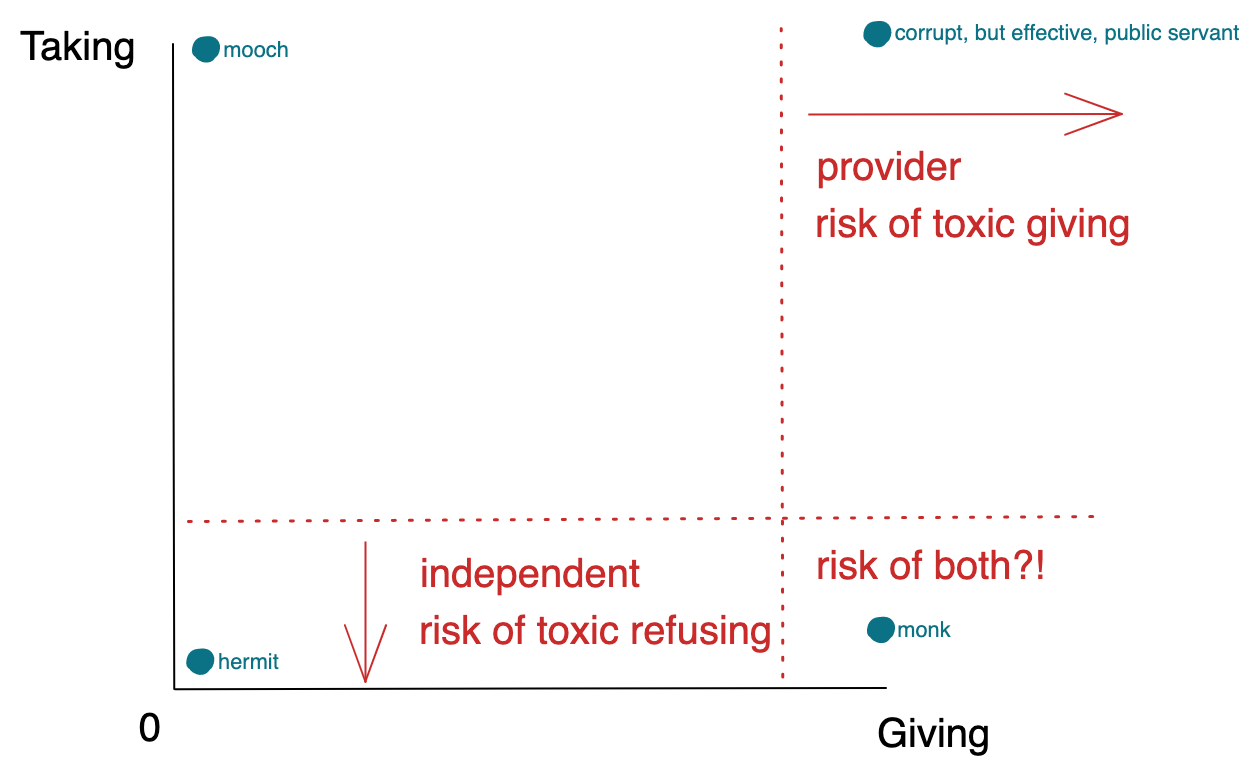
Let's zoom in on "toxic giving", seen on the upper right of the graph.
If over-giving is any giving that has "gone too far" and created an imbalance, then toxic giving arises when over-giving is accompanied by a few other nefarious elements.
To use a "threshold term", we could say that toxic giving is when over-giving becomes pathological (i.e. causing harm in some way).
Through our participation in "give-and-take trust relationships", we have a sensitivity to being given things. There's a positive pressure being exerted on everyone to take part and we want to achieve balance. In a healthy situation the actual "balance" is mutually-beneficial. Everyone is better off if they take part because the system is working for them.
I think the heart of toxic giving is that it's not a mutually-beneficial situation, but one party is acting like it is. Toxic giving exploits our usual instincts in a way that subverts the comradary and trust we get from normal give-and-take interactions.
Toxic giving can come from anywhere, but I've experienced a few common sources:
- a "savior complex" - a person wants to be the person that solves problems. Their motiviation is not the benefit of other people, it's the accolades or social status of being the savior.
- compulsively being needed - someone is defining themselves solely by their ability to give and might not know how to exist without providing. What would happen if they weren't needed?
- imposing their will - giving in such a way that benefits them or enforces their ideal scenario, but doesn't take into account what everyone else wants or needs
- a pre-emptive strike - knowing that there's an imbalance somewhere else, even if it's completely unrelated, so they load the proverbial chamber with kindness-laced bullets, just in case
- garden-variety manipulation - the simple knowledge that giving will make them more inclined to do something for you
All of these things are extremely subtle and difficult to parse out, a breeding ground for gaslighting. If you find yourself consistently upset at someone for "all the things you do for them", or the inverse, then maybe it's time to take a step back and think through the situation a bit more closely.
This short forray into toxic giving reminded me of a metaphor about one source of our suffering, which feels particularly relevant here.
We all have our own "crosses to bear"; life's hardships made manifest as wooden lowercase "t"s that we have to lug around. There's a certain humility to the metaphor, whereby we know difficult things will happen and we accept the hardship as necessary, for ourselves or others. Are all of our crosses like this, though? Is every weight we shoulder equal? What about that one?
Plot twist: you put it there. (:O)
Sometimes this is a source of toxic giving and sometimes it's just unnecesary, self-contained suffering. In either case, "putting the cross on your own back" is often a mistake and complaining about it won't win you any sympathy.
Jesus was being marched to his own death spurred on by whips, sacrificing his life for the sins of humanity by defying the oppressive rule of the Romans.
For this, the person would be marching through the streets alone, hunched and grunting. You'd go up to them and ask if you can help and they'd say, "No! It's my cross to bear" and they'd march on, moaning. You'd try to ask why they're carrying the cross and they'd say "I do it for you...for the people". You'd never met this person before, nor were you expecting any cross deliveries. You'd look around and see none of "the peole" in sight. You'd suggest that a truck rental might be a better approach and they'd look at you in sidelong contempt.
This phenomenon is some self-righteous combination of:
- doing something no one asked you to do to
- doing it in an unnecessarily cumbersome way
- refusing help that is freely available and hardly an imposition on the giver
The cherry-on-top is complaining about the burden or scolding those around you. It's kind of a combination of toxic giving while toxic refusing.
There are real, unavoidable crosses that we have to deal with and life is hard enough as-is. Don't make it harder for yourself or, more importantly, for others.
You're welcoooome for this article and all the other things I do for you! I can't believe you didn't do that one thing for me, even after all of this?! Ugh, the burdens I bear.
The natural structures of give-and-take relationships are sacred institutions that help us live happier, healthier lives. We have instincts tuned to help us navigate them and keep "the balance". Toxic giving is one of many ways that these instincts can be exploited because it preys upon our desire to be a contributing part of any situation.
It's helpful to take a solemn inventory of any give-and-take relationships you have, especially if you're feeling tension from them.
If you can, take off all those crosses you've been shoving on your back, relax and stay awhile.
