README is empty

Daniel interrogator

This file contains hidden or bidirectional Unicode text that may be interpreted or compiled differently than what appears below. To review, open the file in an editor that reveals hidden Unicode characters.
Learn more about bidirectional Unicode characters
| #!/usr/bin/env python | |
| """ | |
| Utility to generate a first-line support message for a user who has submitted a roundup issue. | |
| To only ever be one-file to discourage feature creep for a small utility. | |
| The only main extensions I'd really consider are automatically posting this message to roundup, | |
| but I don't think this is a good idea, as you may need to generate a couple of messages till | |
| an appropriate one is generated |
interrogator
/ process-palette.json
Last active
December 11, 2019 12:47
This file contains hidden or bidirectional Unicode text that may be interpreted or compiled differently than what appears below. To review, open the file in an editor that reveals hidden Unicode characters.
Learn more about bidirectional Unicode characters
| { | |
| "patterns": { | |
| "P1": { | |
| "expression": "(path):(line)" | |
| }, | |
| "P2": { | |
| "expression": "(path)\\s+(line)", | |
| "path": "(?:\\/[\\w\\.\\-]+)+" | |
| } | |
| }, |
This file contains hidden or bidirectional Unicode text that may be interpreted or compiled differently than what appears below. To review, open the file in an editor that reveals hidden Unicode characters.
Learn more about bidirectional Unicode characters
| #!/usr/bin/env python3 | |
| # the thing above is called a shebang. it tells your shell what program to use | |
| # to run this script. in this case, it says, this is python3. this makes it possible | |
| # to run the script by typing `thod...`, rather than `python3 thod ...` | |
| # the thing below is a module docstring. it's where you describe what the script | |
| # is and how it works. it shows up if you do `thod --help` | |
| """ |
This file contains hidden or bidirectional Unicode text that may be interpreted or compiled differently than what appears below. To review, open the file in an editor that reveals hidden Unicode characters.
Learn more about bidirectional Unicode characters
| #!/usr/bin/env python3 | |
| """ | |
| Script to make a plain text corpus of PTSD narratives, | |
| with a little bit of metadata. | |
| """ | |
| import os | |
| import time | |
| import requests |
interrogator
/ tundra-api.sh
Last active
June 29, 2017 09:23
Using TüNDRA API to get matches from given CONLL-U V2
This file contains hidden or bidirectional Unicode text that may be interpreted or compiled differently than what appears below. To review, open the file in an editor that reveals hidden Unicode characters.
Learn more about bidirectional Unicode characters
| # query a conll file | |
| CONLLU2_FILE="/Users/danielmcdonald/Downloads/test.conllu" | |
| QUERY="[pos=/V.*/]" | |
| LANGUAGE="german" | |
| API="https://weblicht.sfs.uni-tuebingen.de/tundra-beta/api/query/visres" | |
| curl -X POST -F "file=@$CONLLU2_FILE" -F "query=$QUERY" -F "lang=$LANGUAGE" "$API" > api-test.json | |
| # query a treebank | |
| ID="UD_French" | |
| QUERY="[pos=/V.*/]" |
Halfway through my PhD candidature in linguistics at Melbourne Uni, I was introduced by Fiona to the ResPlat family. One of their aims, I was told, was to train researchers across the university in emerging tools and methods for doing better, more reproducible research. A specific target of this agenda was the Humanities and Social Sciences, who, let's admit, sometimes lag behind a little when it comes to engagement with digital tools and methods.
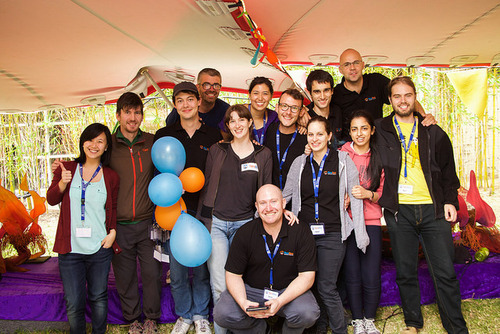
IMAGE OF RESPLAT http://67.media.tumblr.com/ede2ddf22557269fd92dd13c4b344c53/tumblr_inline_nk9gcyW6pE1ssbz72.jpg "ResPlat Family"
My thesis was about corpus linguistics—that is, using computers to locate patterns in large collections of written text. Because of this, Fiona asked me if I could come on board and help out, teaching Python to researchers around the university, but with extra focus on those from the humanities. A key issue among corpus linguists, however, is that many don't really know how to code. A more common w
This file contains hidden or bidirectional Unicode text that may be interpreted or compiled differently than what appears below. To review, open the file in an editor that reveals hidden Unicode characters.
Learn more about bidirectional Unicode characters
| %matplotlib notebook | |
| import seaborn as sns | |
| import numpy as np | |
| from scipy.spatial.distance import pdist | |
| from scipy.cluster.hierarchy import linkage, dendrogram | |
| # pdist can be 'braycurtis', 'canberra', 'chebyshev', 'cityblock', 'correlation', 'cosine', | |
| # 'dice', 'euclidean', 'hamming', 'jaccard', 'kulsinski', 'mahalanobis', 'matching', | |
| #'minkowski', 'rogerstanimoto', 'russellrao', 'seuclidean', 'sokalmichener', 'sokalsneath', 'sqeuclidean', 'yule' |
interrogator
/ sample.py
Created
May 15, 2016 08:39
This file contains hidden or bidirectional Unicode text that may be interpreted or compiled differently than what appears below. To review, open the file in an editor that reveals hidden Unicode characters.
Learn more about bidirectional Unicode characters
| from corpkit import * | |
| corpus = corpus('corpus_name') | |
| langmod = corpus.make_language_model('modelname') | |
| # score string | |
| langmod.score('Check similarity for this text to each corpus') | |
| # score file | |
| corpus_file = corpus.subcorpora[5].files[1] | |
| langmod.score(corpus_file) |
This file contains hidden or bidirectional Unicode text that may be interpreted or compiled differently than what appears below. To review, open the file in an editor that reveals hidden Unicode characters.
Learn more about bidirectional Unicode characters
| # a list of ints | |
| l = [4, 2, 6, 7, 8, 1, 50, 23, 13, 55, 12, 3] | |
| # one line to sort them! | |
| [l.insert(ind, l.pop(l.index(min(l[ind:])))) for ind in range(len(l))] | |
| # see? | |
| print(l) | |
| # elaborated code |
NewerOlder