
1. 5.05 & 5.06 – Explain the meaning of each of the themes in 5.05 in your own words. Use 5.06 to help with describing some of them.
- Nationalism: love and devotion for one's heritage and birthplace rather than one's personal beliefs usually much more in political: National Identity with focus in expanding their territories lik England to India and Africa.
- Individualism: The imginative genius showed what individuals were capable of
- Exoticism:  nonwestern cultures as "exotic", Many writers used this theme to transport readers to a location which they may never have heard of, let alone visited.
- Revolution: European countries were making outward changes, they also underwent important internal changes: internal change.(calls for action against tyranny, oppressive social and cultural conditions, and for the equal rights for all people
- heroism: talented but non-traditional, used as a vessel to challenge deeply rooted customs, The embodiment of this theme was fashioned after Lord Byron. His qualities are listed as: exceptional, misunderstood, and gifted loner, who was driven by passion.
- Nature: Interest in nature and in representing nature in the arts, Many of the Romantic writers found wisdom and solace in nature and strove to convey this theme to their readers.
- Passion: It inspired Writer and artis fovor affection than rational and logical sentiments
- Idealism: the only knowledge we have of the world is knowledge of our mental experiences.
- Transcendentalism: people must become free and self-reliant by returning to nature
- Nationalism: it's about unity or cohesion among people live in the area governed by that state.
- Emerson: transcendentalism
- Nietzche: idealism
- Wordsworth most connected to nature: "The Prelude"
- Keats also connected to A nature : "Ode on a Grecian Urn"
- Heroism in "The Corsair"
- Sublime: something so overwhelming it goes beyond words.
    - Sublime: a quality of greatness and vastness that is beyond calculation, comparison, or imitation: often invoked with reference to nature.
    - Example: American Romantic writers consider Amarica is sublime in contrast with English writer.
- Whitman best represent: Transcendentalist which fit in theme: Nature of this period
- Gothic literature sought to address larger Romantic themes in a darker way(disharmony). : Mary Shelley in Frankenstein whch inpired by Prometheus chreated man from clay in Ancient Greek
9. 5.09 – What are “slave narratives” and what is their purpose? What themes from the period would you say they fit in with?
- Slave narratives combined reason, sympathy, and empathy to make a statement about the plight of slaves in the United States and to provide a narrative rallying cry for abolitionist action
- Purpose to support African-American worment's rights.
- This fit it Romantic Period: Revolution Thems
10. 5.10 – What type of literature from the Romantic Period is Poe’s poem, “The Raven”? What does the raven represent in the poem?
- "The Raven" is another Gothic literature.
- "The Raven" represent symbols of death.
- Gothic Revival is an architectural movement that began in the late 1740s in England. It's a movement that celebrated the religiosity of older Gothic buildings with different building materials, such as iron, steel, and glass.
- emphasis on passion, emotion, nature beauty and exotic setting and subjects
- in paiting: brighter colors and rapid, brushstrokes evoke emotions
- themes of nature, heroism, sensuality and grotesque
- in sculpture, heroic and expressive figures
- in archetecture: the Gothic Revival movement
13. 5.11 – Pick 1 painting from three of the artists in the tabs (three paintings altogether, all from different artists) and explain what themes you see in the paintings.
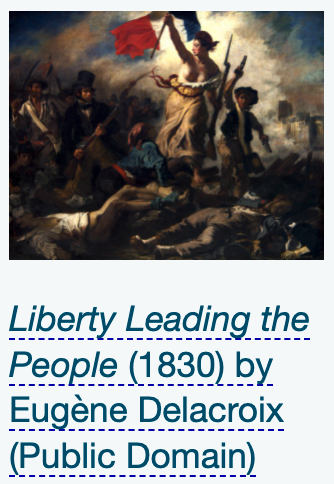
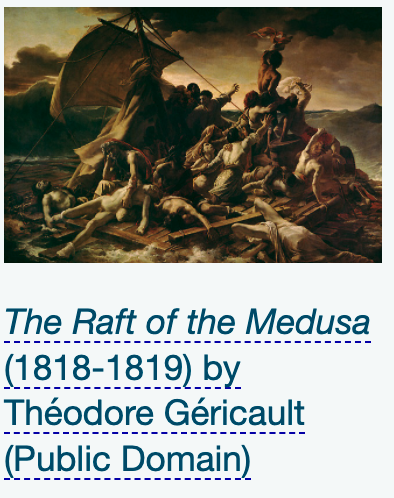
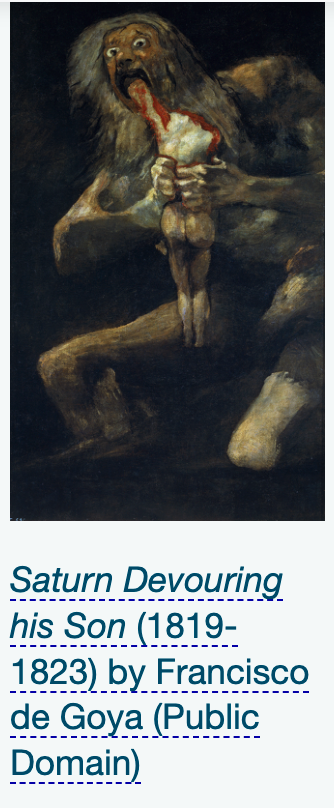
- Liberty Leading the People (1830) by Eugène Delacroix (Public Domain): Themes: Revolution, Passion(using women hold flag with death men around)
- The Raft of the Medusa (1818-1819) by Théodore Géricault (Public Domain): Themes: Nature(Sea) and  Passion(using French tragedy, the wreck of a ship )
- Saturn Devouring his Son by Goya: Theme: Passion in horror, fear subjective creativity, irrationality, and superstition.
- Passion
- Nationalism
- Chopin: Passion by his skill and expressivity
- Strauss: Passion by his work of "God is dead" which critques of Christianity and Christian ideals.
- Franz Liszt: Nationalism by "Hungarian Rhapsody No. 2" which mix of Hungarian music and gypsy folk music.
16. 5.14 – Explain how exoticism has influence on cultural exchange in the period. How does nationalism reflect cultural exchange?
- Exorticism via better communication create diverse works and worldview that looked down upon Eastern cultures.
- Nationalism via music, visual art in Wlfgang, Joseph Yaydn and Grorge Frideric Handel.
17. 5.15 – What is often the purpose of chromaticism in a song and what modern song was influenced by it?
- Chromaticism: make emotionally unsettled which "The Star-Spangled Banner US national anthem was influenced by it.
"
- The Romantic song: "To Anacreon in Heaven" provided the setting for other patriotic songs such as U.S. Congress (in 1931) as the official national anthem, "The Star-Spangled Banner."

