You signed in with another tab or window. Reload to refresh your session.You signed out in another tab or window. Reload to refresh your session.You switched accounts on another tab or window. Reload to refresh your session.Dismiss alert
{{ message }}
Instantly share code, notes, and snippets.
🎯
Focusing
michele-tn
🎯
Focusing
Software Engineer | Cybersecurity Enthusiast — B.Sc. in Computer Science from UNIBA.
#################################### 🅷🅰🅿🅿🆈🅷🅰🅲🅺🅸🅽🅶 !!
kill_hbbs_hbbr_connections.sh is a Bash script designed to terminate active network connections on specific RustDesk server ports without stopping or killing the RustDesk server processes (hbbs and hbbr).
kill_hbbs_hbbr_connections.sh — Description
Overview
kill_hbbs_hbbr_connections.sh is a Bash script designed to terminate active network connections on specific RustDesk server ports without stopping or killing the RustDesk server processes (hbbs and hbbr).
The script is intended for system administrators running a self-hosted RustDesk server who need to:
Bash script for deep Ubuntu system cleanup with an interactive safety prompt. Supports Safe and Aggressive profiles to balance disk recovery and log preservation. Removes Snap permanently, purges leftover kernels, optimizes APT behavior, vacuums journald logs, and optionally runs BleachBit with shredding. Designed for Ubuntu 22.04 (Jammy), VPS, …
Ubuntu Cleanup Script (Safe / Aggressive Modes)
This Gist contains a single Bash script that automates a deep cleanup of an Ubuntu system (Jammy-friendly).
The script includes an interactive safety prompt that adapts the cleanup strategy depending on how the system is used, allowing you to choose between a Safe and an Aggressive cleanup profile.
Everything is intended primarily for server / VPS / minimal Ubuntu systems.
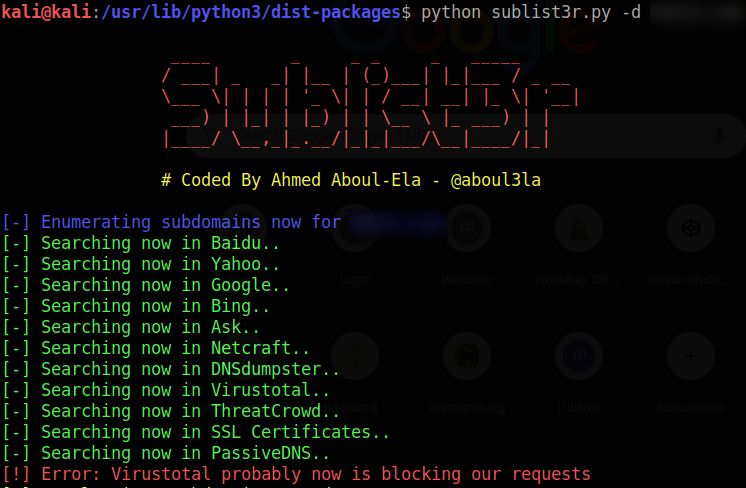
Sublist3r is a Python tool designed to enumerate subdomains of websites using OSINT.
Sublist3r Installation and Usage Guide (Ubuntu 22.04.5 LTS)
Sublist3r is a Python tool designed to enumerate subdomains of websites using OSINT. It helps penetration testers and bug hunters collect and gather subdomains for the domain they are targeting. Sublist3r enumerates subdomains using many search engines such as Google, Yahoo, Bing, Baidu, and Ask. Sublist3r also enumerates subdomains using Netcraft, Virustotal, ThreatCrowd, DNSdumpster, and ReverseDNS.
subbrute was integrated with Sublist3r to increase the possibility of finding more subdomains using bruteforce with an improved wordlist. The credit goes to TheRook who is the author of the subbrute.
This document explains how to install, run, and clean up Sublist3r when it is installed directly from the official GitHub repository.
RustDesk Portable Auto Downloader & Configurator (Windows x64)
This repository provides a PowerShell script that automatically downloads, configures, and launches the RustDesk Windows x64 portable client, using only your self-hosted ID server and public key.
It is ideal for:
🔧 Mass deployment (RMM, GPO, Intune, etc.)
🧰 Technicians who need a ready-to-use portable RustDesk client
💼 Environments where software installation is restricted
This file contains hidden or bidirectional Unicode text that may be interpreted or compiled differently than what appears below. To review, open the file in an editor that reveals hidden Unicode characters.
Learn more about bidirectional Unicode characters
Secure Guest SFTP User on Ubuntu 22.04 - test on Ubuntu 22.04.5 LTS (GNU/Linux 5.15.0-156-generic x86_64)
Secure Guest SFTP User on Ubuntu 22.04.5
Abstract
In multi-user environments, providing controlled access to file transfer services is a
recurring requirement. This document describes a structured procedure for configuring a
non-privileged user account on Ubuntu 22.04.5 with access restricted exclusively to SFTP.
Additionally, it outlines the optional configuration of reverse TCP tunneling over SSH,
intended for controlled administrative or connectivity use cases. The configuration
ensures compliance with security best practices by removing administrative privileges,
Hash functions are ubiquitous in information security: they are used for integrity checks, content-addressed storage, digital signatures, password verification, and more. This document treats three families of constructions that have received the most attention in practice and in the literature: MD5 (an historical design of the MD family), SHA-2 (notably SHA-256, standardized in FIPS 180), and SHA-3 (the Keccak-based family standardized in FIPS 202). Where necessary we contrast the design principles (MerkleDamgrd vs. sponge) and explain the consequences for security. Key primary sources are cited: the MD5 specification (RFC 1321), the SHA standards (FIPS 180-4), the SHA-3 standard (FIPS 202), and major cryptanalytic work on MD5 and related constructions. citeturn0search0turn0search7turn3search2
2. Formal definitions and basic security notions
Let (H:{0,1}^* o{0,1}^n) be a deterministic function mapping binary strings of arbitrary length to fixed-length (n)-bit o