
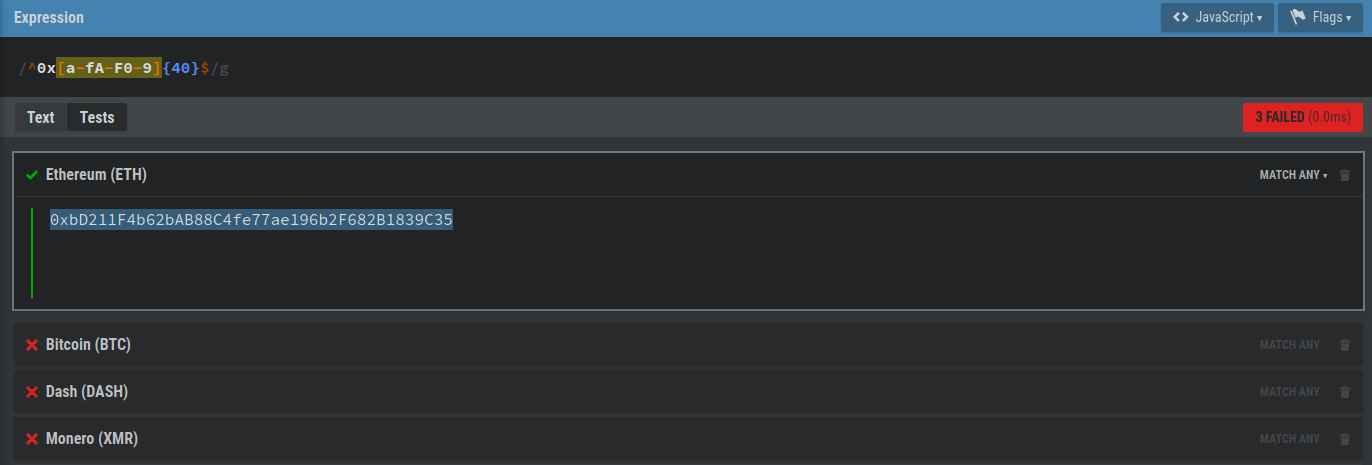
The following regular expressions are crafted to match some commonly used cryptocurrency wallet address types. This document details the Regex components and pattern tests to match Ethereum, Bitcoin, Dash and Monero addresses.
/^0x[a-fA-F0-9]{40}$/g

| (?i)((access_key|access_token|admin_pass|admin_user|algolia_admin_key|algolia_api_key|alias_pass|alicloud_access_key|amazon_secret_access_key|amazonaws|ansible_vault_password|aos_key|api_key|api_key_secret|api_key_sid|api_secret|api.googlemaps AIza|apidocs|apikey|apiSecret|app_debug|app_id|app_key|app_log_level|app_secret|appkey|appkeysecret|application_key|appsecret|appspot|auth_token|authorizationToken|authsecret|aws_access|aws_access_key_id|aws_bucket|aws_key|aws_secret|aws_secret_key|aws_token|AWSSecretKey|b2_app_key|bashrc password|bintray_apikey|bintray_gpg_password|bintray_key|bintraykey|bluemix_api_key|bluemix_pass|browserstack_access_key|bucket_password|bucketeer_aws_access_key_id|bucketeer_aws_secret_access_key|built_branch_deploy_key|bx_password|cache_driver|cache_s3_secret_key|cattle_access_key|cattle_secret_key|certificate_password|ci_deploy_password|client_secret|client_zpk_secret_key|clojars_password|cloud_api_key|cloud_watch_aws_access_key|cloudant_password|cloudflare_api_key|cloudflare_auth_k |

The following regular expressions are crafted to match some commonly used cryptocurrency wallet address types. This document details the Regex components and pattern tests to match Ethereum, Bitcoin, Dash and Monero addresses.
/^0x[a-fA-F0-9]{40}$/g

| KEYMAPOPTS="us us" | |
| HOSTNAMEOPTS="-n alpine" | |
| INTERFACESOPTS="auto lo | |
| iface lo inet loopback | |
| auto eth0 | |
| iface eth0 inet dhcp | |
| hostname alpine | |
| " | |
| TIMEZONEOPTS="-z UTC" |

| cd /home/<user>/ | |
| sudo apt-get install unzip | |
| wget https://dl.google.com/android/repository/sdk-tools-linux-4333796.zip | |
| unzip sdk-tools-linux-4333796.zip -d Android | |
| rm sdk-tools-linux-4333796.zip | |
| sudo apt-get install -y lib32z1 openjdk-8-jdk | |
| export JAVA_HOME=/usr/lib/jvm/java-8-openjdk-amd64 | |
| export PATH=$PATH:$JAVA_HOME/bin | |
| printf "\n\nexport JAVA_HOME=/usr/lib/jvm/java-8-openjdk-amd64\nexport PATH=\$PATH:\$JAVA_HOME/bin" >> ~/.bashrc | |
| cd Android/tools/bin |

| from btgym import BTgymEnv | |
| import IPython.display as Display | |
| import PIL.Image as Image | |
| from gym import spaces | |
| import gym | |
| import numpy as np | |
| import random |

I’m looking for any tips or tricks for making chrome headless mode less detectable. Here is what I’ve done so far:
Set my args as follows:
const run = (async () => {

    const args = [
        '--no-sandbox',
        '--disable-setuid-sandbox',
        '--disable-infobars',
| # IMPORTANT! | |
| # This gist has been transformed into a github repo | |
| # You can find the most recent version there: | |
| # https://github.com/Neo23x0/auditd | |
| # ___ ___ __ __ | |
| # / | __ ______/ (_) /_____/ / | |
| # / /| |/ / / / __ / / __/ __ / | |
| # / ___ / /_/ / /_/ / / /_/ /_/ / | |
| # /_/ |_\__,_/\__,_/_/\__/\__,_/ |

This guide is unmaintained and was created for a specific workshop in 2017. It remains as a legacy reference. Use at your own risk.
Workshop Instructor:
This workshop is distributed under a CC BY-SA 4.0 license.

Code is clean if it can be understood easily – by everyone on the team. Clean code can be read and enhanced by a developer other than its original author. With understandability comes readability, changeability, extensibility and maintainability.
