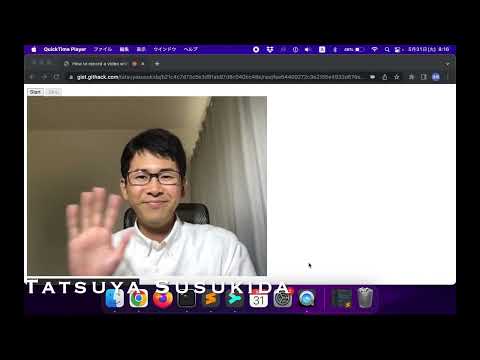
This article describes how to shoot a video from JavaScript using the MediaStream Recording API. The related resources are shown below.

Nuri nkev

oscarmarina
/ isFocusable.js
Last active
June 25, 2025 02:34
Checks if an element is focusable - treewalker = walkComposedTree(this, NodeFilter.SHOW_ELEMENT, isFocusable);
This file contains hidden or bidirectional Unicode text that may be interpreted or compiled differently than what appears below. To review, open the file in an editor that reveals hidden Unicode characters.
Learn more about bidirectional Unicode characters
| /** | |
| * Checks if an element should be ignored. | |
| * @param {Element} element - The DOM element to check. | |
| * @param {Array} [exceptions=['dialog', '[popover]']] - Array of Elements to ignore when checking the element. | |
| * @returns {boolean} True if the element should be ignored by a screen reader, false otherwise. | |
| */ | |
| const isElementInvisible = (element, exceptions = ['dialog', '[popover]']) => { | |
| if (!element || !(element instanceof HTMLElement)) { | |
| return false; | |
| } |

tatsuyasusukida
/ !README-javascript-media-video.md
Last active
June 28, 2025 17:22
🎥 How to record a video with JavaScript [demo video available]

austinhyde
/ js-observables-binding.md
Last active
January 7, 2025 08:27
Vanilla JavaScript Data Binding
You don't really need a framework or fancy cutting-edge JavaScript features to do two-way data binding. Let's start basic - first and foremost, you need a way to tell when data changes. Traditionally, this is done via an Observer pattern, but a full-blown implementation of that is a little clunky for nice, lightweight JavaScript. So, if native getters/setters are out, the only mechanism we have are accessors:
var n = 5;
function getN() { return n; }
function setN(newN) { n = newN; }

console.log(getN()); // 5
setN(10);