
Look at the following image...
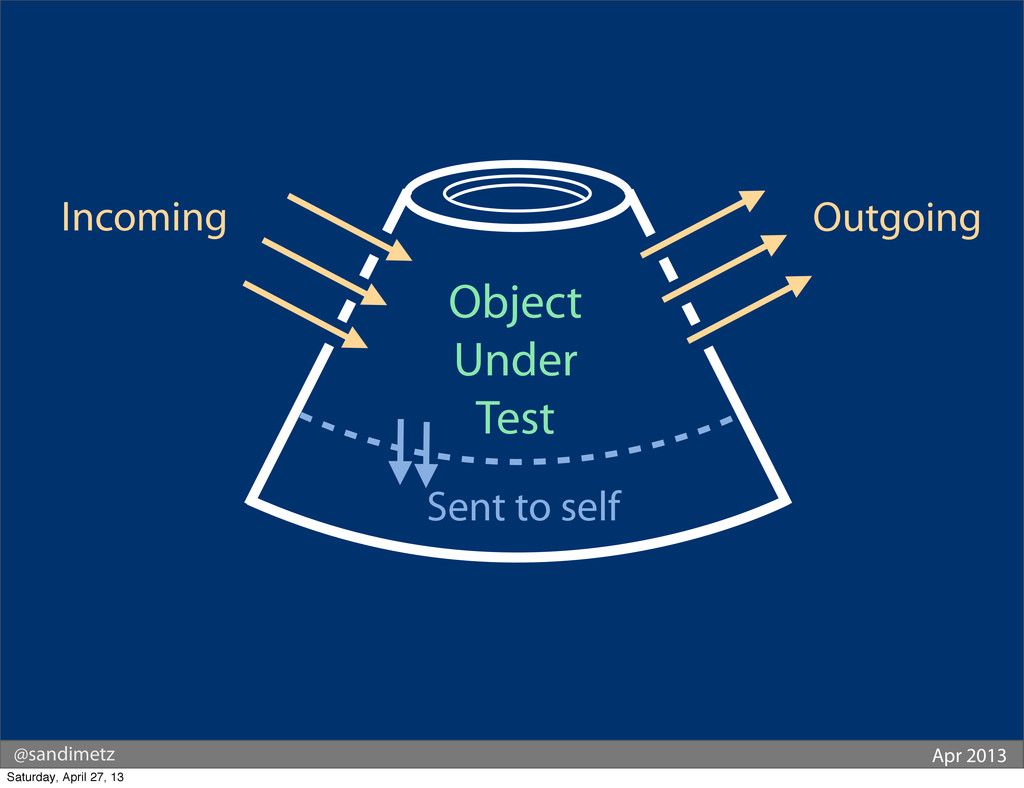
...it shows an object being tested.
You can't see inside the object. All you can do is send it messages. This is an important point to make because we should be "testing the interface, and NOT the implementation" - doing so will allow us to change the implementation without causing our tests to break.
Messages can go 'into' an object and can be sent 'out' from an object (as you can see from the image above, there are messages going in as well as messages going out). That's fine, that's how objects communicate.
Now there are two types of messages: 'query' and 'command'...
Queries are messages that "return something" and "change nothing".
In programming terms they are "getters" and not "setters".
Commands are messages that "return nothing" and "change something".
In programming terms they are "setters" and not "getters".
- Test incoming query messages by making assertions about what they send back
- Test incoming command messages by making assertions about direct public side effects
- Messages that are sent from within the object itself (e.g. private methods).
- Outgoing query messages (as they have no public side effects)
- Outgoing command messages (use mocks and set expectations on behaviour to ensure rest of your code pass without error)
- Incoming messages that have no dependants (just remove those tests)
Note: there is no point in testing outgoing messages because they should be tested as incoming messages on another object
Command messages should be mocked, while query messages should be stubbed
Contract tests exist to ensure a specific 'role' (or 'interface' by another - stricter - name) actually presents an API that we expect.
These types of tests can be useful to ensure third party APIs do (or don't) cause our code to break when we update the version of the software.
Note: if the libraries we use follow Semantic Versioning then this should only happen when we do a major version upgrade. But it's still good to have contract/role/interface tests in place to catch any problems.
The following is a modified example (written in Ruby) borrowed from the book "Practical Object-Oriented Design in Ruby":
# Following test asserts that SomeObject (@some_object)
# implements the method `some_x_interface_method`
module SomeObjectInterfaceTest
  def test_object_implements_the_x_interface
    assert_respond_to(@some_object, :some_x_interface_method)
  end
end

# Following test proves that Foobar implements the SomeObject role correctly
# i.e. Foobar implements the SomeObject interface
class FoobarTest < MiniTest::Unit::TestCase
  include SomeObjectInterfaceTest

  def setup
    @foobar = @some_object = Foobar.new
  end

  # ...other tests...
end

Ah ruby isn't my strong suit. Let me digest that first. Right off the bat I'd put what you wrote and what we wrote into two axes: testing that the implementation works vs. defining the behavior spec so we can refactor. I'm leaning heavily onto the latter, with very little observable value-add on the former.
You seem to favor implementation-assurance over all else (or at least more than I do) for the sake of example.
Did I get that right so far?
Fundamentally what I reason about differently is I would never write a test such as:
"given API returns rain" -> "SUT returns raincoat"Instead I would test
"given person in London and it's raining in London" -> "SUT returns raincoat"And important, this also exposes the need to expose the base cases:
"given person's location is unknown" -> "SUT returns error with usage instructions""given person in London and weather at (or near) person's location is unknown" -> "SUT provides sorry message"This small change would emphasise the semantics that the person's location and the weather are related and actually part of an underdesigned behavior contract, and not a collaborator contract.
Once you got the upstream (what-do-I-wear-side) of the code right and have 5-6 tests for the core behaviors, you can probably squeeze in a single test to cover the location + weather resolution, API, cache or otherwise but at that point it will be modelled correctly as an implementation detail for information retrieval and not in any way be related to decision-making.